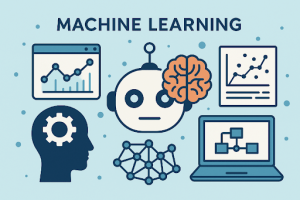
1. What Machine Learning Really Is
In traditional programming, a human developer writes explicit instructions (algorithms) and feeds them data to get an output:
In machine learning, the computer is given data and the desired outcomes (answers), and it figures out the rules or patterns connecting them:
Think of it like teaching a child what a dog looks like. Instead of giving them a rigid mathematical definition (e.g., “four legs, pointed ears, tail length between 10–30cm”), you show them dozens of pictures of dogs. Eventually, the child forms a mental concept of a dog and can correctly identify a new dog they’ve never seen before. That is essentially what an ML model does.
2. How It Works: The Machine Learning Pipeline
Underneath the hood, training an ML model is a structured, multi-step process:
-
Data Collection & Preparation: The model is only as good as its data. Engineers gather massive datasets (images, text, numerical logs) and clean them—removing errors, filling in missing pieces, and labeling data if necessary.
-
Feature Extraction: The system identifies key attributes (features) that help distinguish objects or patterns. For a photo, features might include pixel colors, edges, shapes, and textures.
-
Training (The Learning Phase): The algorithm processes the data using a mathematical model. It makes a prediction, measures how wrong it is (using a loss function), and tweaks its internal weights (parameters) to reduce that error using optimization techniques like gradient descent. This cycle repeats thousands or millions of times.
-
Evaluation: Once trained, the model is tested on a separate set of “unseen” data to see how well it generalizes rather than just memorizing the training examples.
-
Inference: The final, trained model is deployed into the real world to make predictions or decisions on brand-new data in milliseconds.
The Three Main Types of Machine Learning
Depending on how the data is structured and what the computer needs to learn, ML is typically split into three core categories:
| Type | How it Works | Example |
| Supervised Learning | The model is trained on labeled data (input + correct answer). It learns to map inputs to outputs. | Email spam filters (emails labeled as “spam” or “not spam”). |
| Unsupervised Learning | The model is given unlabeled data and must find hidden structures, clusters, or patterns on its own. | Customer segmentation for targeted marketing based on purchasing behavior. |
| Reinforcement Learning | An agent learns by trial and error, receiving rewards for good actions and penalties for bad ones in an environment. | Teaching an AI to play chess or drive an autonomous vehicle. |
3. Everyday Examples of Machine Learning
Machine learning powers much of the modern digital ecosystem quietly behind the scenes:
-
Content Recommendations (YouTube, Netflix, Spotify): Algorithms analyze your watch history, skips, likes, and the behavior of millions of other users with similar tastes to predict what you will want to watch or hear next.
-
Email Spam Filters: Every time you mark an email as spam (or move a legitimate email out of your spam folder), the ML model updates its understanding of what spam looks like—looking at sender addresses, keyword frequencies, and link structures.
-
Predictive Text & Autocorrect: Smartphones use natural language processing models (a branch of ML) to predict the next word you are likely to type based on context and your personal typing habits.
-
Fraud Detection: Banks use anomaly-detection algorithms to monitor credit card transactions in real-time, instantly flagging unusual spending patterns that deviate from your normal behavior.
-
Speech Recognition (Siri, Alexa, Google Assistant): Acoustic models convert raw audio waveforms into phonemes, and language models translate those phonemes into coherent text and actionable intent.