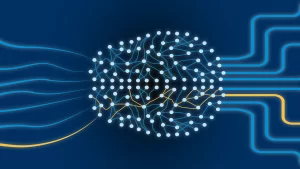
1. What Deep Learning Really Is
While standard machine learning often requires humans to manually select features (e.g., telling an algorithm to look for whiskers or pointed ears to identify a cat), deep learning handles feature extraction on its own.
It achieves this using artificial neural networks inspired loosely by the interconnected neurons of the biological human brain. The word “deep” refers to the many layers (dozens or even hundreds) stacked on top of each other through which data must pass. Each layer extracts progressively more abstract features:
-
Early layers might detect simple edges, lines, or basic contrast.
-
Middle layers combine those edges to recognize shapes, textures, or components (like a nose or an eye).
-
Deep final layers assemble those parts to recognize the complete object (like a specific person’s face or a spoken sentence).
2. How It Works: Layers and Neural Networks
Under the hood, a deep learning model is a massive web of mathematical functions passing signals to one another:
-
Inputs and Weights: Data enters the input layer. As it moves from one artificial neuron to the next, it passes through weights (which determine how important a given signal is) and biases.
-
Activation Functions: These mathematical gates decide whether a neuron should “fire” (pass the signal forward) based on whether the incoming pattern meets a certain threshold.
-
Backpropagation & Training: During training, the network makes a guess, calculates its error using a loss function, and sends that error backward through the layers via backpropagation. It tweaks millions or billions of weights simultaneously so it makes fewer mistakes next time.
-
Massive Scale: Because deep learning models contain so many parameters, they require enormous amounts of training data and heavy-duty computing power (like specialized GPUs and TPUs) to train successfully.
3. Everyday Examples of Deep Learning
Deep learning is the engine behind modern artificial intelligence breakthroughs:
-
Facial Recognition (Face ID): Infrared dot projectors map your facial structure, and deep neural networks analyze those depth maps to match them against stored mathematical representations of your face, even accounting for changes like glasses, beards, or aging.
-
Real-Time Language Translation: Tools like Google Translate or live captioning apps use deep learning sequence models to capture context across entire sentences rather than translating word-by-word.
-
Generative AI (ChatGPT, Midjourney, Stable Diffusion): Advanced Large Language Models (LLMs) and diffusion models use deep neural networks containing billions of parameters to understand context, write code, compose text, or generate photorealistic images from text prompts.
-
Autonomous Driving (Tesla, Waymo): Self-driving cars process raw video feeds from multiple cameras simultaneously via deep learning to identify pedestrians, traffic signs, lane markings, and moving obstacles in real-time.
-